

Glass vs Resin Memorial Jewellery


 ★★★★★
5.0 out of 5
based on 3,722+ reviews
★★★★★
5.0 out of 5
3,722+ reviews
★★★★★
5.0 out of 5
based on 3,722+ reviews
★★★★★
5.0 out of 5
3,722+ reviews
When researching memorial jewellery, you may come across pieces made using kiln-fired glass or resin. At first glance, these materials can appear similar. Both can hold ashes and both can be crafted into jewellery or keepsakes. However, the way they are made, how they behave over time, and how they respond to everyday wear are fundamentally different.
This guide explains those differences clearly, including how each material is produced, how it ages, and what that means for long-term durability and appearance.
How Memorial Glass Is Made
Memorial glass jewellery is created by permanently fusing cremation ashes within specialist art glass at high temperature. Rather than being suspended in a liquid material, the ashes become physically enclosed within solid glass during firing.
The process begins with careful preparation of the ashes. Small amounts are positioned between layers of coloured or clear glass before being placed into a kiln and heated to temperatures typically ranging between 750–1,200°C, depending on the technique used.
At these temperatures, the glass softens and fuses into a single unified structure. As it cools, the ashes remain permanently encapsulated within the glass matrix itself.
After firing, the piece is cooled gradually through a controlled annealing process. This relieves internal stress and increases long-term structural stability before the glass is shaped, polished and set using traditional fine jewellery techniques.
Because kiln-fired glass is an inorganic material formed through heat rather than chemical curing, the finished surface is solid, non-porous and structurally stable under normal environmental conditions.
How Resin Memorial Pieces Are Made
Resin memorial jewellery is created using a liquid polymer material, typically an epoxy or polyurethane system. Cremation ashes are mixed into or positioned within the resin before it solidifies.
The resin is poured into a mould or directly into a jewellery setting. Depending on the formulation, curing may occur through a two-part chemical reaction or under exposure to ultraviolet light. UV-cured resins can harden within minutes, while two-part systems may take several hours or longer to fully set.
Once cured, the material forms a solid plastic polymer surface that can be shaped and polished. The ashes remain visible within the hardened resin layer.
Because resin is a polymer-based material rather than an inorganic glass, its long-term behaviour depends on formulation, thickness and environmental exposure. Over time, factors such as ultraviolet light, heat and surface wear may influence clarity, colour stability and rigidity.
Glass vs Resin: A Practical Comparison
A factual comparison of kiln-fired glass and resin, focusing on material behaviour and long-term performance.
Remains clear and stable over time.
Highly resistant to UV-related discolouration.
Remains structurally stable beyond normal environmental conditions.
Generally more resistant to surface scratching and can be professionally polished.
Non-porous and stable when exposed to water and humidity.
Chemically stable under typical exposure to household products and cosmetics.
Designed for long-term structural stability.
May yellow or cloud depending on UV exposure and formulation.
UV stability varies and may reduce over time depending on exposure.
As a polymer-based material, resin can soften at elevated temperatures (often around 50–80°C), depending on formulation and environment.
More susceptible to surface scuffs and marks.
Water-resistant, though repeated exposure may affect surface appearance over time.
Surface appearance may change with repeated exposure to perfumes, alcohol-based products or stronger cleaning agents.
Long-term performance depends on formulation and environmental exposure.
Differences in molecular structure help explain variation in heat response, UV behaviour and long-term surface stability.
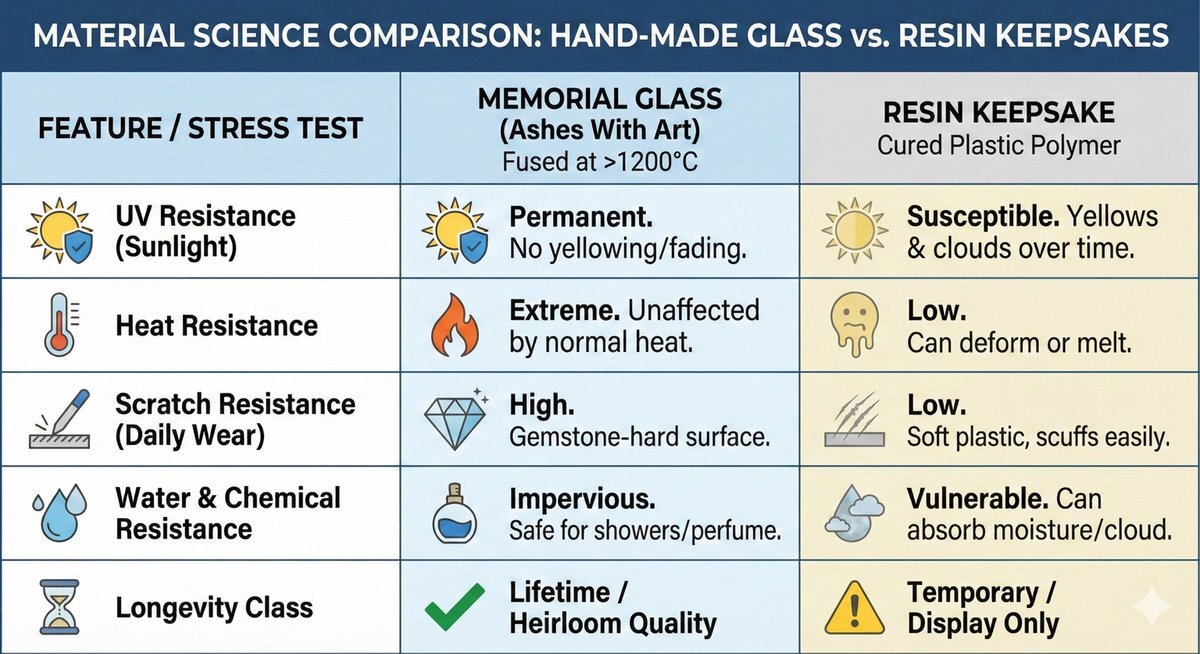
Summary comparison of material behaviour under UV exposure, heat, surface wear and environmental conditions.
How Each Material Ages Over Time
All materials respond differently to long-term exposure to light, temperature changes, moisture and everyday handling. Understanding how glass and resin behave over time helps clarify the practical differences between them.
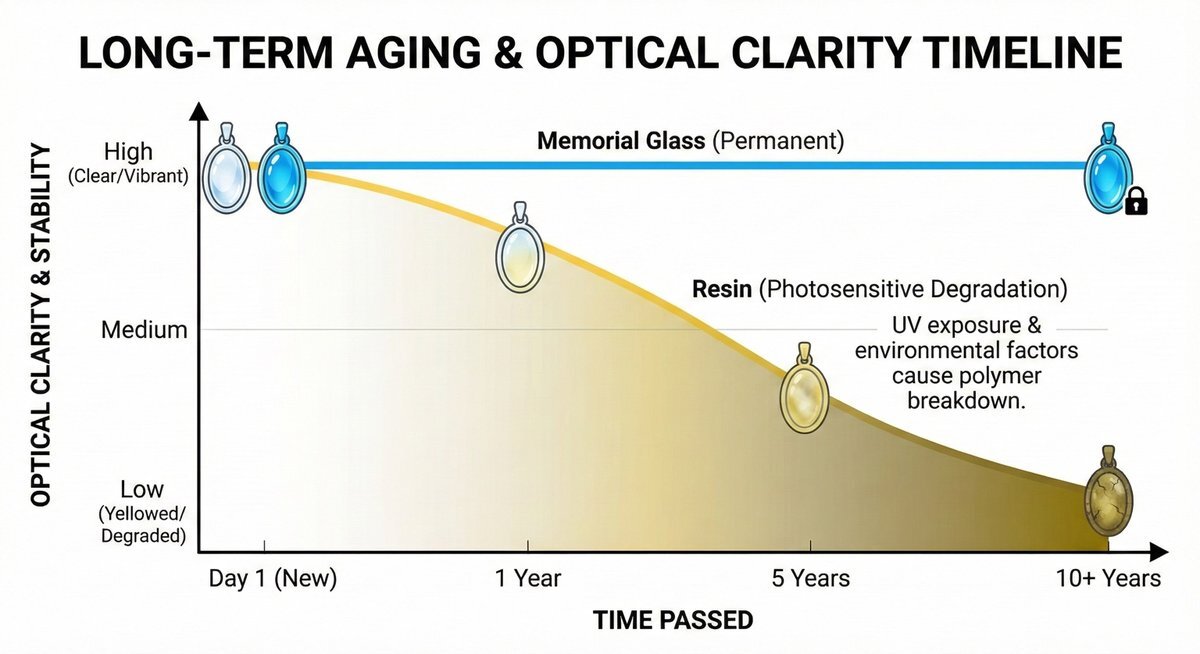
Kiln-fired glass is an inorganic material formed through high-temperature fusion. Because its colour is integrated within the glass structure during firing, it does not rely on surface coatings or suspended dyes. Under normal environmental conditions, the glass matrix remains structurally stable and highly resistant to UV-related discolouration.
Resin is a polymer-based material created through a curing process. Over extended periods, environmental factors such as ultraviolet light, heat exposure and surface wear may influence its clarity and rigidity, depending on formulation and thickness.
Temperature response is another distinction. Glass remains structurally stable well beyond normal day-to-day environmental temperatures. Polymers, by contrast, can gradually soften when exposed to elevated heat over time, as their molecular structure responds differently to temperature.
Surface wear also varies. Glass is generally harder and more resistant to scratching, while resin surfaces may show fine marks more readily with regular contact.
These differences are material characteristics rather than quality judgments. Each material behaves according to its composition, and long-term performance depends on environmental exposure and care.
Different Types of Memorial Jewellery Construction
Memorial jewellery can be created using different structural methods. While many pieces may look similar externally, the way ashes are incorporated and secured inside the jewellery can vary significantly.
Kiln-Fired Memorial Glass Jewellery
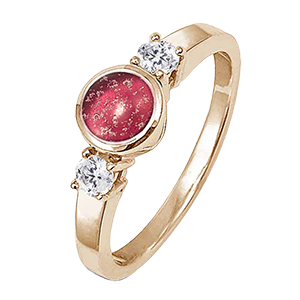
In kiln-fired memorial glass jewellery, cremation ashes are permanently fused within solid glass at high temperature. The ashes become enclosed inside the glass structure during firing and remain visible within the finished gemstone. The piece is not hollow, and the ashes are not suspended in a liquid material.
Resin Memorial Jewellery
Resin memorial jewellery uses a liquid polymer material that cures into a solid form. Ashes are typically placed within a setting or mould and surrounded by resin before curing. Once hardened, the ashes remain visible inside the polymer surface.
Sealed Chamber Jewellery
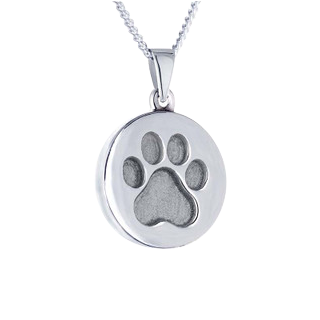
Sealed chamber jewellery contains a hollow compartment within the metal design. Ashes are placed inside this internal cavity and then permanently sealed by the maker. The ashes are not visible, and the chamber is not intended to be reopened once closed.
Self-Fill Memorial Jewellery
Self-fill memorial jewellery also contains a hollow compartment, but it is designed to be filled by the customer. The jewellery typically closes using a threaded screw or plug mechanism. In these designs, sealing and long-term closure depend on the fastening method and user handling.
Understanding these construction methods helps clarify whether ashes are visible, permanently fused, chemically cured, sealed within metal, or placed into a re-openable compartment.
Understanding Permanence and Construction
In memorial jewellery, the concept of permanence relates to both material behaviour and structural design. Different construction methods secure ashes in different ways, and long-term stability depends on how those materials respond to environmental exposure.
Kiln-fired glass permanently encloses ashes within a solid inorganic structure formed through high-temperature fusion. Resin surrounds ashes within a cured polymer material. Sealed chamber jewellery contains ashes inside a metal compartment that is closed by the maker, while self-fill jewellery relies on threaded or screw mechanisms.
Permanence therefore depends on factors such as material composition, sealing method, exposure to light and temperature, and everyday handling. Understanding how each construction method functions helps clarify expectations for long-term durability and care.
When researching memorial jewellery, considering both visible appearance and internal construction can provide a clearer understanding of how the piece is designed to perform over time.
Continue Your Research
If you would like to explore this topic further, the pages below provide more detail on different methods and how memorial jewellery is made.
- What Is Sealed Chamber Memorial Jewellery? – understand how ashes are permanently enclosed within the metal.
- Resin vs Sealed Chamber Method – a comparison of durability, security and long-term performance.
- Why We Don’t Use Resin – a detailed explanation of our material approach.
- How Memorial Jewellery Is Made – a step-by-step overview of our jewellery making process.
Frequently Asked Questions
Resin can change in appearance over time depending on formulation, UV exposure and environmental conditions.
Some resins may develop yellowing or clouding when exposed to prolonged sunlight or heat.
The degree of change varies by product and manufacturing method.
Kiln-fired glass is a non-porous inorganic material and does not absorb water.
When properly set within jewellery, it remains stable under normal day-to-day exposure to moisture.
Resin is a polymer-based material and can become more flexible at elevated temperatures, often in the range of 50–80°C depending on formulation.
While this does not necessarily mean failure, structural rigidity may change under prolonged heat exposure.
Professionally kiln-fired coloured glass is highly resistant to UV-related discolouration.
Unlike some polymer-based materials, it does not typically yellow when exposed to sunlight.
Self-fill jewellery allows the wearer to add ashes through a threaded or screw mechanism.
Sealed jewellery is filled and permanently closed by the maker using soldering or laser welding techniques.
The construction method affects long-term structural integrity and maintenance.
Resin used in jewellery is a type of synthetic polymer.
While formulations vary, it behaves similarly to other plastic-based materials in how it responds to heat and UV exposure.
Longevity depends on environmental exposure and construction method.
Glass is an inorganic material and remains structurally stable under normal conditions.
Resin performance depends on formulation, curing process and exposure to heat and light.
No. Urn pendants typically contain ashes inside a hollow metal chamber.
Memorial glass jewellery permanently fuses ashes within a solid glass structure formed through kiln firing.
The internal construction and long-term behaviour differ significantly.